How AI will impact life of average designer — #copingwithAI
Welcome to #CopingWithAI — episode 6— a series of articles for designers navigating the rise of AI. It started as a one-off rant because, honestly, I’m scared of what AI is doing to our jobs, our industry, and the way we work. But writing turned out to be cheaper than therapy, so it became a series. While I’ve been pretty loud about my concerns, I’m also exploring how AI might actually help, not just replace us. If you’re feeling the same mix of dread and curiosity, you’re in the right place. And yes — “coping” is from cope, not copy. English is weird. So is the future.
7 min read
Remember the moment I closed Photoshop for the last time. Not literally, of course, it’s still on my machine, maybe, quietly sitting somewhere on my dock, but practically, that chapter had closed. Like many designers of my generation, I had spent a good chunk of my early career perfecting the art of layer organisation, mastering layer styles, exporting assets manually, and building UI kits pixel by pixel in Photoshop. And I hope to never-ever do that again. Literally, reject it.
Then Figma came along and changed everything (and there was also Sketch). Real-time collaboration, cloud libraries, and auto-layout it felt like cheating. And last week, Figma went public with its long-anticipated IPO, cementing its place not just as a powerful design tool but as a defining symbol of the profession’s evolution.
We adapted. Some slower than others, but we did it.
Now, the same unease I saw when Figma first arrived is surfacing again -only this time, it’s not a tool, but a force: artificial intelligence. Not just a new plugin or feature set. A completely new way of working, one that challenges the very idea of what design work means and who — or what -should be doing it.
So, the question that’s been echoing in studio hallways and Slack threads is this: Is AI replacing designers, or is it transforming what it means to be one?
This article is not a doomsday prophecy, nor a glorified course review, like I do on this page GO_AND_CHECK_OTHER_REVIEWS_ARTICLES_NOW 😂. It’s a reflection on the ways AI is showing up in our workflows, the numbers behind its adoption, the risks and opportunities it presents, and the road ahead for designers, and increasingly, for business professionals, as the design market evolves.
From tools to workflows: What is really changing?
One of the first things AI promised was speed, and it has delivered, at least in pockets of our workflow. The tasks we used to do manually for hours are being shaved down to minutes, or at least some of them.
Take asset generation. A few years ago, if you needed twenty variations of a banner in different sizes, you either built a Figma component system with variants and constraints or duplicated and manually resized each one. Now, tools like Adobe Firefly or Figma’s built-in AI helpers can generate variants on command. Resize, reflow, or even rewrite text if needed.
For ideation, the transformation is even more striking. Midjourney, DALL·E, and Firefly are not just art generators — they’re collaborators. You type a sentence, and they show you a visual. It’s not always perfect, and rarely final, but it gets you past the blank canvas. For some, it’s a springboard. For others, it’s uncomfortable — because it’s fast, confident, and visual, just like us, supposed to be.
Adobe Sensei, which has been quietly embedded into Creative Cloud for years, now offers personalised design suggestions based on your history and behaviour. It recognises your layout preferences, colour choices, and even naming patterns. The more you work, the more it learns.
We’re also seeing AI creep into UX design with personalisation at scale. Tools now use behavioural data to adapt experiences in real-time. Designers aren’t just creating interfaces, they’re designing adaptive systems that respond to individual users. It’s no longer one-size-fits-all; it’s one-size-for-each (or at least it’s on track for it).
But with all this acceleration, there’s a lingering question: if AI can do parts of our work faster-maybe even better-what does that mean for our role?
Personally, it’s a weird mix. Some of the work AI is taking over — like early wire-framing and low-fidelity exploration- is what I actually enjoy. I like the quiet focus of building logic in flows, setting up a system. Meanwhile, the more emotionally demanding parts — the parts that require real-time empathy, negotiation, social fluency — those can’t be outsourced, and I wouldn’t mind letting go of them a bit more. On the other hand, I have no trust in AI-produced content, and don’t even say that I‘m just bad at prompting, I’m trying.
A market-wide shift
This isn’t just a design story anymore. Business professionals are joining the conversation, and in many cases, leading it. Product owners, stakeholders, marketers- they’re all using AI to mock up flows, create content, even sketch interface drafts. It’s becoming common for designers to receive not just briefings but visual materials generated by tools like ChatGPT’s image integration or Canva Magic Design.
But this mirrors something we’ve seen before. Years ago, stakeholders would submit hand-drawn wireframes or PowerPoint slides with UI suggestions. Now they use AI. The tool changed, but the intent didn’t — they’re trying to communicate. They want to take part in shaping the product.
This shift doesn’t diminish design. It reframes it. Designers must now earn trust not just by delivering visuals but by guiding discussions, curating direction, and knowing when to pivot. The expertise hasn’t gone away — it just has to be articulated more clearly and defended more intelligently.
BTW, reading (or mostly looking at pictures) the book Visual Collaboration. It teaches how to use visuals to facilitate complex thinking and shared understanding. In a time when everyone has access to generative visuals, knowing how to guide a visual conversation is key. And in general, it is an eye-candy, check it out here.
Human-AI relationship
It’s tempting to see AI as a threat. After all, it produces visuals. It writes copy. It generates UI. It’s fast. It doesn’t sleep. It doesn’t overthink. But it also doesn’t understand context. It doesn’t feel what a brand feels like. It can’t fight for a design decision in a stakeholder meeting. It won’t notice that a form field is redundant or that a button label is emotionally tone-deaf.
AI is a tool. And like any tool, it’s only as good as the person wielding it. More than that, it can become a trainee — learning from your preferences and evolving based on your choices. But it’s not a replacement for judgment, taste, ethics, or empathy. Those are still, for now, unmistakably human traits.
Agentic design, which I’ve already written about in my article AX as a New Branch of Well-Known UX, emphasises that we’re not just designing interfaces — we’re designing systems that include intelligent agents. That changes how we think about flows, outcomes, and even responsibilities.
What the data says and what it doesn’t
According to McKinsey’s 2024 research on AI and productivity, designers and marketers using generative AI tools reported a 30 to 40 per cent reduction in time spent on routine tasks like asset resizing, layout replication, and copy tweaking etc. Adobe’s internal studies on Sensei claimed up to a 25 percent reduction in iteration cycles when designers used automated layout suggestions and content-aware edits. It didn’t mean they stopped iterating — but they got to the good version faster.
Figma users in beta programs of AI features, including the “Make Design” plugin and built-in wireframe helpers, reported a significant drop in time-to-first-concept, especially in early-stage ideation or for smaller deliverables like landing pages and banners. Platforms like Canva have also leaned hard into AI features, launching Magic Design and Magic Write. According to Canva’s 2024 usage report, over 60 percent of pro users used at least one AI feature per project in the past quarter.
These tools are doing more than accelerating production. They’re changing who produces. As more business roles gain access to visual creation tools, the designer’s role expands from builder to curator, facilitator, and strategic thinker.
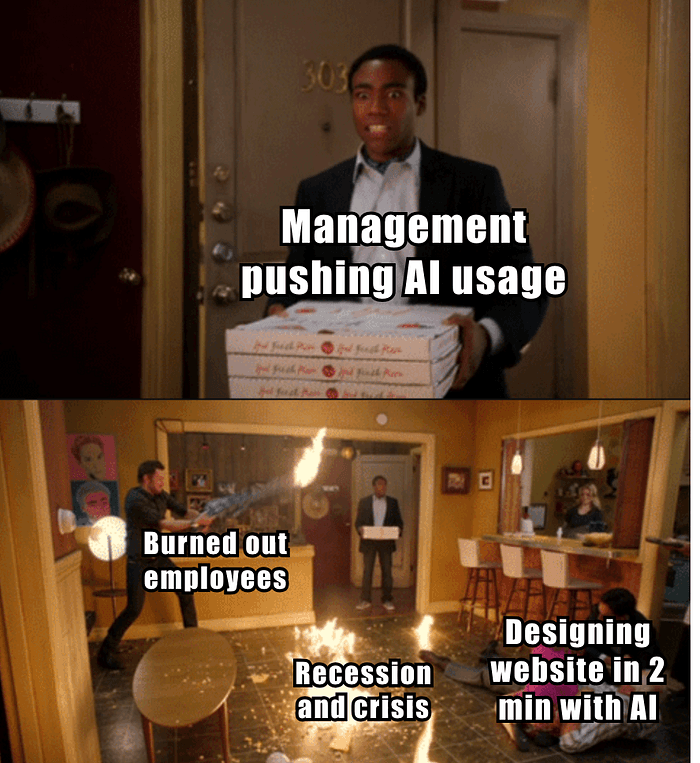
But also, there’s always another side. Over-reliance risks and creativity impact: McKinsey’s workforce surveys caution that excessive dependence on AI outputs may reduce critical thinking and novel idea generation unless designers actively counteract this. McKinsey’s 2025 US CxO and employee surveys reveal that employees report greater AI use than leadership expects. This mismatch often leads to pressure on designers to deliver more quickly, requiring management of realistic AI capabilities to clients.
Industry reports and expert blogs underline integration challenges and the need for transparency and human creativity oversight to avoid loss of originality.
Press enter or click to view image in full size
So, where were we?
AI is here. And like any new thing, it’s still a buzzword. But also it does not seem to be a passing trend or a gimmick. It’s already reshaping our workflows, nudging us to rethink how we create, collaborate, and communicate.
The core of our work — solving problems, connecting with users, making ideas real — remains deeply human. AI can help us do that work more efficiently, maybe even more creatively. But it can’t do it alone.
To my fellow designers who once already moved from Photoshop to Figma, or God forbid, from some CorelDraw, and are now staring down another uncertain shift: you’ve done this before. You’ll do it again. The tools will change, but the value of thoughtful, human-centred design endures. Trust and reputation were always the currency of design leadership. Today, they matter even more.
Join the newsletter
Be the first to read our articles.